

Project Overview
The MELA-SUPFIX project focuses on the development of a conceptual model and its application with real data for the generation of new Evapotranspiration (ET), Water Use Efficiency (WUE), and Nitrogen Use Efficiency (NUE) products.
The project will develop and validate a suite of novel retrieval algorithms and innovative prototype products for ET, WUE, and NUE, based on the combined capabilities of the forthcoming satellite missions:
These products will be configured to match Sentinel-2/CHIME/LSTM/FLEX/ROSE-L spatial resolutions, enabling improved monitoring of land processes through integrated Earth observation.
Project Objectives
Conceptual Model Development
Develop a comprehensive conceptual model for integrating multisource Earth observation data to assess land processes.
Algorithm Development
Create and validate novel retrieval algorithms for ET, WUE, and NUE products using combined mission capabilities.
Data Integration
Harmonize existing datasets for calibration/validation and develop workflows for future ET, WUE, and NUE monitoring.
Experimental Campaign
Conduct ground and airborne measurements campaigns in 2026 for validation of developed products and methods.
Target Missions
The project specifically targets the following Earth observation missions (click for more information):
- Sentinel-2 - Multispectral imaging mission
- FLEX (Fluorescence Explorer) - Measures plant fluorescence
- LSTM (Land Surface Temperature Mission) - Thermal infrared mission
- CHIME (Copernicus Hyperspectral Imaging Mission) - Hyperspectral imaging
- ROSE-L (Radar Observing System for Europe - L-band) - L-band SAR mission
Specific Technical Objectives
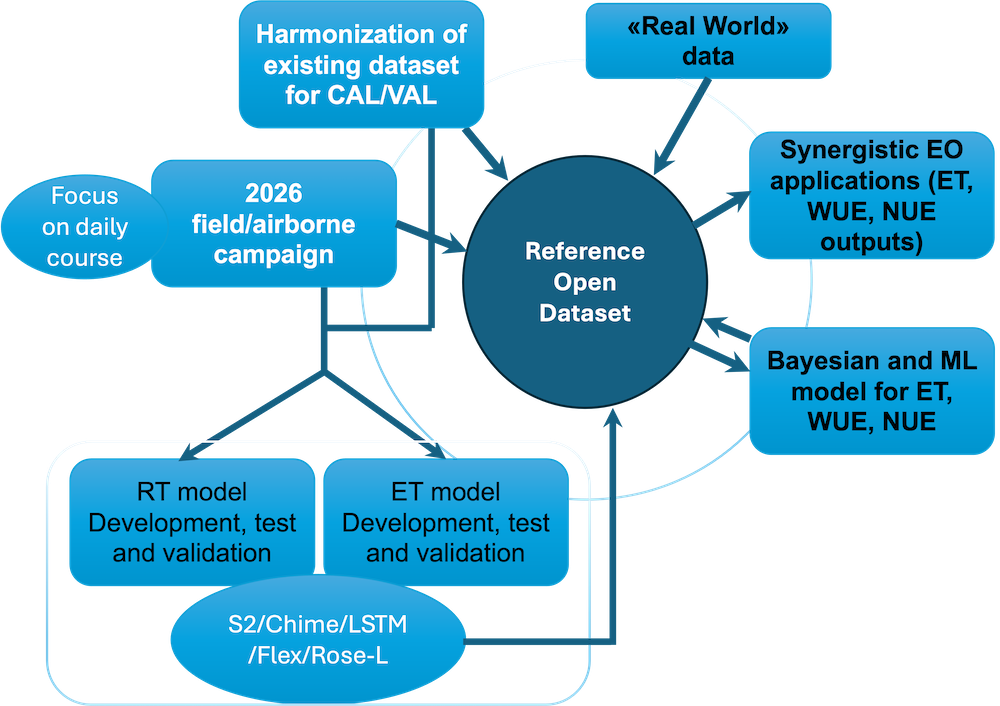
- Harmonization of existing data for calibration/validation and identification of gaps in the historical dataset with reference to the selected target area.
- Design of a new field/airborne campaign and collect new data in 2026 to complement the pre-existing dataset with a special attention to the improvement of the representation of the daily course of key parameters.
- Develop, test and validate a RT model to simulate reflectances, temperatures, and fluorescences in Sentinel2/CHIME/LSTM/FLEX configuration (L2 products).
- Estimate ET using traditional models based on past data and the new campaign (benchmark) at LSTM resolution.
- Development (training and validation) of Bayesian and Machine Learning models, as well as physical models, for the estimation of ET, WUE, and NUE.
- Developing a 3D simulation for indirect validation for the LSTM/CHIME/FLEX missions.
- Recommendations for synergistic EO applications.
- Generate a Reference Open Dataset for the i) storage of historical and new data, ii) run the models developed along the project in operational mode with real data to generate ET, WUE and NUE outputs.

Project Timeline
Key Campaign Periods
Experimental Campaign 2026: Ground and airborne measurements including hyperspectral and fluorescence data collection (May-July 2026).
Grosseto Dataset: Pre-existing data from 2017-2025 will be utilized for model development and validation.
Work Packages
The MELA-SUPFIX project is organized into several work packages covering different aspects of the research and development process.
Scientific Requirements
Definition and consolidation of scientific requirements for the project.
Experimental Campaign
Logistics, ground measurements, airborne RS, and airborne fluxes activities.
Reference Open Dataset
Conceptual design, generation, and harmonization of reference open database.
SCOPE RT Model
Testing and validation of SCOPE RT model for land process monitoring.
ET Estimation
Evapotranspiration estimation via SEBI-like approaches.
Optimal Estimation
Development of methods for WUE, NUE and ET retrieval using optimal estimation.
Machine Learning
Development of WUE, NUE and ET retrieval using Machine Learning techniques.
Validation
Validation of proposed retrieval methods using ground and airborne measurements.
Synthetic Validation
Synthetic validation using 3D models for algorithm testing.
Workflow Pipeline
Development of workflow and pipeline for future ET, WUE and NUE monitoring.
Outreach & Synergies
Promotion, outreach activities and collaboration synergies.
Project Partners
The MELA-SUPFIX project brings together leading research institutions and organizations:




Click on any partner logo to visit their official website
Key Deliverables
Science Requirements (SR)
This deliverable will report the detailed description of the science plan of the project, including:
- The overall consolidated scientific approach.
- The site selection with the pre-existing datasets.
- The general plan of the experimental campaign.
- The detailed description of the methodological approach to be developed including algorithm development plans and the validation methods.
- A consolidated plan for the development of ROD.
Additional Deliverables
- ATBD (Algorithm Theoretical Basis Document) - October 2026
- SAR (Science Analysis Report) - September 2027
- Scientific Roadmap - February 2028
- Harmonized datasets for calibration and validation
- MELA modelling tool with SIF integration strategies